

Five is a number very present in our lives. We have 5 fingers and toes, most starfishes have 5 arms, there are five human senses, five vowels, and five Olympic rings, just to mention some!
One of the main mathematical properties of 5 is that it is a prime number, as we are about to learn.
We will start recalling some definitions that we have widely discussed in our Prime Numbers article. If you still feel unfamiliar with these notions, we invite you to first read that article and come back here later.
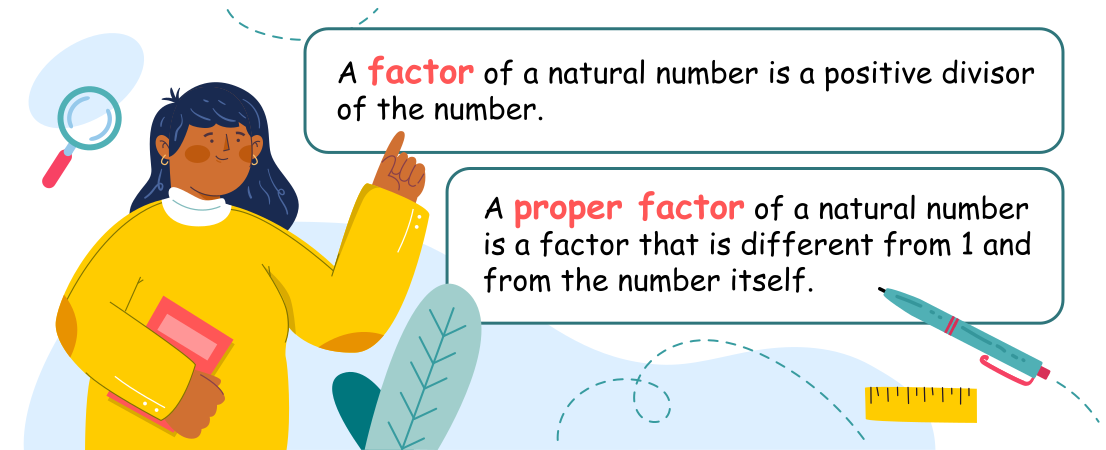
A factor of a natural number is a positive divisor of the number. A proper factor of a natural number is a factor that is different from 1 and from the number itself.
For example, ; thus, 1, 5, 7, and 35 are all factors of 35, but only 5 and 7 are proper factors of 35.
A natural number is called a prime number if it is greater than 1, and it doesn’t have proper factors. For example, the first prime numbers are 2 and 3.
A composite number is a natural number that has proper factors. As we saw, 35 has two proper factors, thus 35 is a composite number.

Why is 5 a prime number?
Number 5 is a prime number because it doesn’t have proper factors. In other words, the only factors of 5 are 1 and itself.
To be sure of it, notice that the integers greater than 1 and less than 5 are: 2, 3, and 4. Since 5 is not even, neither 2 nor 4 is a factor of 5. Moreover, , thus the remainder of dividing 5 by 3 is 2. In other words, 3 isn’t a factor of 5 either.
Therefore, 5 is the third prime number, preceded by 2 and 3.
Example: Is 215 a prime number?
To answer this question, we should verify if 215 has proper factors. Since 215 ends in 5, we know that 5 is a factor of it: . In other words, 5 and 25 are proper factors of 125.
This means that 125 is a composite number, it isn’t prime! In fact, we don’t need to find all the proper factors of 125 to ensure it is composite, we only need to find one proper factor, and we know one from the beginning: it is 5.
As a result, we have the following rule.
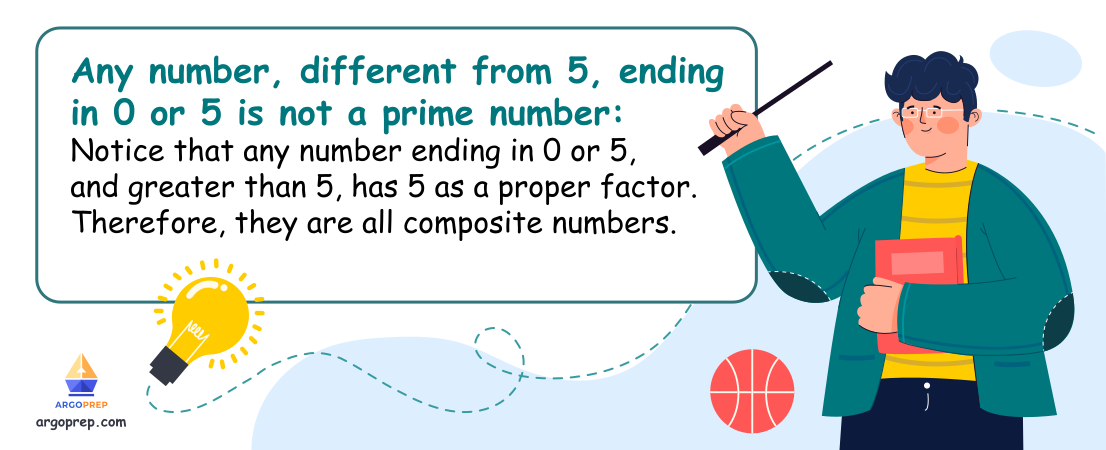
Any number, different from 5, ending in 0 or 5 is not a prime number: Notice that any number ending in 0 or 5, and greater than 5, has 5 as a proper factor.
Therefore, they are all composite numbers. For example, , which means that 85 is a composite number. The same can be said about .
Which class of prime number is 5?
One amazing thing about 5 is that it is a prime number which is the sum of two other primes: 5 = 2 + 3.
Since it is the 3rd prime number, and 3 is also prime, 5 belongs to the class of super-prime numbers: they are the prime numbers that occupy a prime position in the list of all prime numbers.
Number 5 can be classified into many different classes of prime numbers. We will name three of them here, and then we will see to which of these classes number 5 belongs.
| Classes of Prime Numbers | ||
|---|---|---|
| Primoral prime | It is a prime number of the form
, or where are the first n prime numbers. |
Yes |
| Mersenne prime | It is a prime number of the form
where n is an integer. |
No |
| Safe prime | It is a prime number of the form
2p+1 where p is also a prime number. |
Yes |
Let’s find out why:
- Notice that , where 2 and 3 are the first two prime numbers. Thus, 5 has the form of a primoral prime.
- Notice that:
Therefore, 5 is between the two Mersenne primes 3 and 7, but it is not a Mersenne prime. Nevertheless, if we use n=5 as exponent, we get which is a prime number. - Notice that using the first prime number p = 2, we get 2(2) + 1 = 5. Thus, 5 is the first safe prime.
We invite you to read other articles on prime numbers, on our webpage, to find out which other prime numbers belong to these classes.
Do you think 31 is a prime or not?