
You surely already know the even numbers: they are the integers having 2 as one of its factors. In other words, 2 is the number that determines which integer s belong to the family of even numbers, and which to the family of odd numbers.

Another exclusivity of 2 is that it is the first prime number, and the unique even prime, as we will find out next.
We will start recalling some definitions that we have widely discussed in our Prime Numbers article. If you still feel unfamiliar with these notions, we invite you to first read that article and come back here later.
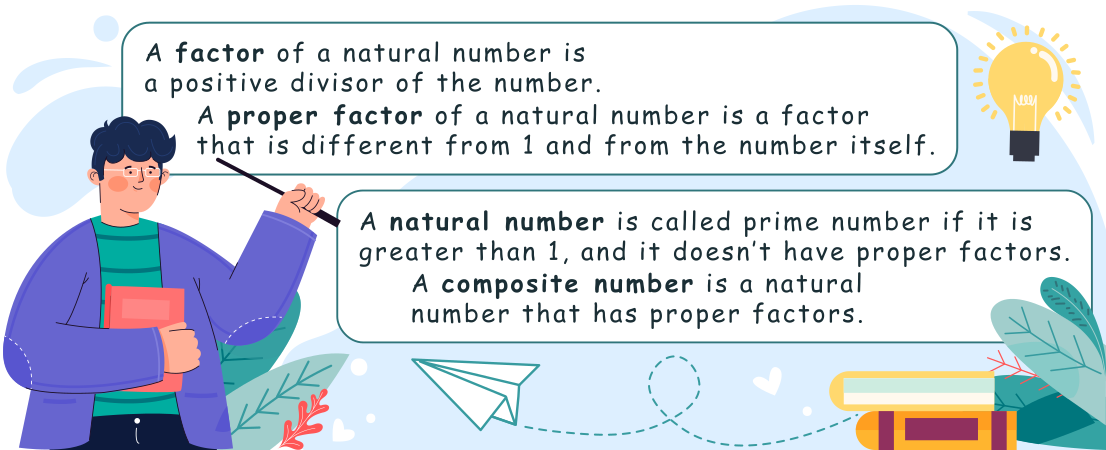
A factor of a natural number is a positive divisor of the number. A proper factor of a natural number is a factor that is different from 1 and from the number itself.
For example, ; thus, 1, 2, 4, 5, 10 and 20 are all factors of 20, but only 2, 4, 5 and 10 are proper factors of 20.
A natural number is called a prime number if it is greater than 1, and it doesn’t have proper factors. As we will see in what follows, 2 is the first prime number.
A composite number is a natural number that has proper factors. As we saw, 20 has several proper factors, thus 20 is a composite number.
Why is 2 a prime number?
Number 2 is a prime number because it doesn’t have proper factors. In other words, the only factors of 2 are 1 and itself: . This is clear because there are no more positive integers less than 2 that could divide it.
On the other hand, 2 is the only prime number that is also even. To see this, notice that any other even number has 2 as a proper factor, meaning it is composite.

Example: Is 48 a prime number?
To answer this question, we should verify if 48 has proper factors. But we know that 48 is even, therefore 2 is a factor of it: . In other words, 2 and 24 are proper factors of 48.
This means that 48 is not prime, it is a composite number! In fact, we don’t need to find all the proper factors of 48 to ensure it is composite, we only need to find one proper factor, and we know one from the beginning: it is 2.
As a result, we have the following rule.
Any number, different from 2, ending in 0, 2, 4, 6, or 8 is not a prime number: Notice that if a number ends in 0, 2, 4, 6 or 8, it is even; but, the only even prime number is 2, thus all numbers ending in 0, 2, 4, 6 or 8 are composite.
This gives us a huge (infinite) list of non-prime numbers: 4, 6, 8, 10, 12… 5798…, 20640, etc.

Which class of prime number is 2?
Besides being the only even prime number, 2 is also the first prime number. Moreover, since 2 is followed by 3, these are the only two consecutive numbers that are primes.
There are many different classes of prime numbers. We will name three of them here, and see why 2 don’t belong to any of them.
| Classes of Prime Numbers | ||
|---|---|---|
| Primoral prime | It is a prime number of the form
, or where are the first n prime numbers. |
No |
| Mersenne prime | It is a prime number of the form
where n is an integer. |
No |
| Safe prime | It is a prime number of the form 2p+1 where p is also a prime number. | No |
Let’s find out why:
- The smallest primoral prime, under our definition, is found considering just the first prime number . Then, p=(2)+1=3, and any other primoral prime is bigger than 3. Thus, 2 is not a primoral prime.
- Notice that:
Therefore, the first Mersenne prime is 3 (0 and 1 aren’t primes), and any other Mersenne prime is greater than 3. Thus, 2 is not a Mersenne prime. - The first safe prime is found using the first prime number p=2: 2(2)+1=5. Thus, any other safe prime is greater than 5, and therefore 2 is not a safe prime.
We invite you to read other articles on prime numbers, on our blog, to find out which other prime numbers belong to these classes. Do you know that 5 is a prime number?