
Anytime you are writing, you want to make sure that you are providing the most accurate information possible. This is because you want your reader to understand you as clearly as possible! Adverb clauses are a tool for you to use to write more clearly.
There are numerous forms of adverb clauses, which are discussed in depth in this guide. However, there are a few rules that much be true to an adverb clause to be correct.
Before we dig into the nuances and intricacies of adverb clauses, let's first establish a working definition.
Adverbial Clauses Defined
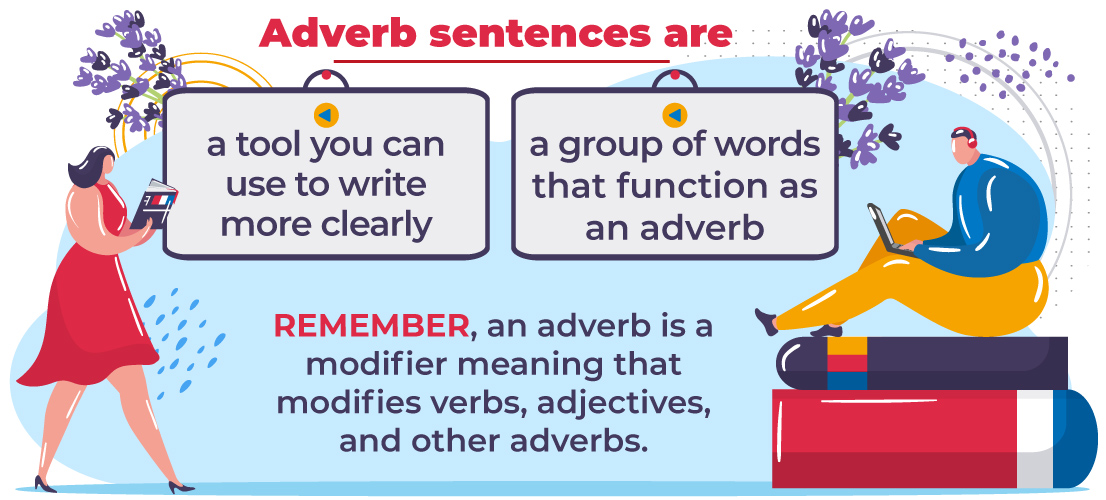
Adverb clauses are a group of words that function as an adverb.
Remember, an adverb is a modifier meaning that modifies verbs, adjectives, and other adverbs.
An adverbial clause is similar and modifies sentences with more accuracy. The term clause is an indicator to you that it contains both a subject and a verb (meaning an adverbial clause is not a single word, but instead a short sentence).
Sometimes adverbial clause transforms sentence into a complex sentence.
The Three Requirements for Adverb Clauses
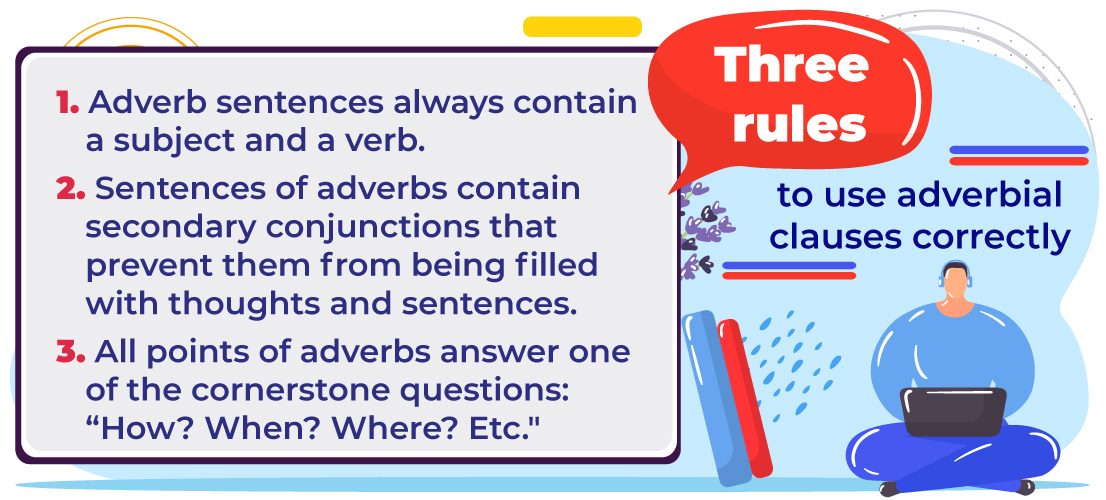
Three rules must be satisfied to use adverbial clauses correctly:
- Adverb clauses always contain a subject and a verb.
- Adverb clauses contain subordinate conjunctions that prevent them from being complete thoughts and sentences.
- All adverbial clauses answer one of the cornerstone questions, "How? When? Where? Etc."
Examples
She walked like a baby deer.
Because of his experience in the field, they hired him immediately.
When she heard the news, she ran home.
Remember how we said that adverbs modified words? An example of this is:
Please knock on the door loudly.
In this example, loudly is an adverb. If you wanted to increase detail, you could use an adverbial clause, which could read like this:
Please knock on the door as loud as possible in case I don't hear you.
NOTE: While writing your essay don't forget about the structure of a sentence.
Different Types of Adverbial Clauses
Beyond the basic definition of adverb clauses, there are many different kinds of adverbial clauses. These include adverbs of time, place, manner, comparison, reason, condition, and concession.
Each of these subtypes of adverbs uses signifying subordinating conjunctions to let the reader know what kind of adverbial clause it is.
[workbook=13584][workbook=13687][workbook=13720]...
Below is a short explanation of each type of adverbial clause.
When?
Adverbs of time state when something is going to happen or how often you can expect something to happen.
While it's not required, an adverb of time usually begins with subordinating conjunction:
| after | as | as long as | as soon as | before |
| no sooner than | since | until | when | while |
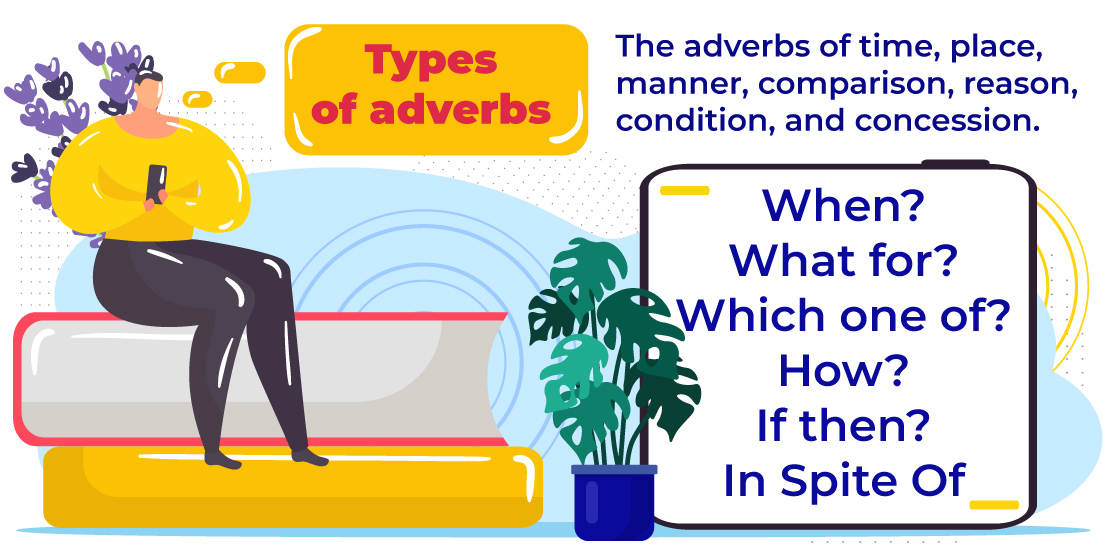
Where?
Adverbs of place explain where something is happening. It usually starts with a preposition or a subordinating conjunction (anywhere, everywhere, where, or wherever).
Why?
Any adverbs of reason aim to provide rationality for the main idea.
It will often start with "as", "because", "given", or "since".
What?
Adverbs of degree or comparison ask the question, "to what degree?".
If you see any of the subordinating conjunctions like "than," "as," "so...as," or "the...the," you can safely assume you are reading an adverb of degree.
How?
An adverb of manner states how something is done. It usually starts with a subordinating conjunction, such as "as," "like," or "the way."
If, Then?
An adverb of condition states the conditions which must be valid for the clause to come into effect.
These clauses are signified with the words "if" and "unless."
In Spite Of
The final type of adverb is an adverb of concession. It is used to contract the main idea.
The critical signifiers of an adverb of concession are "though", "although", "even though", "while", "whereas", and "even if".
"When are We Going to Use This!?"
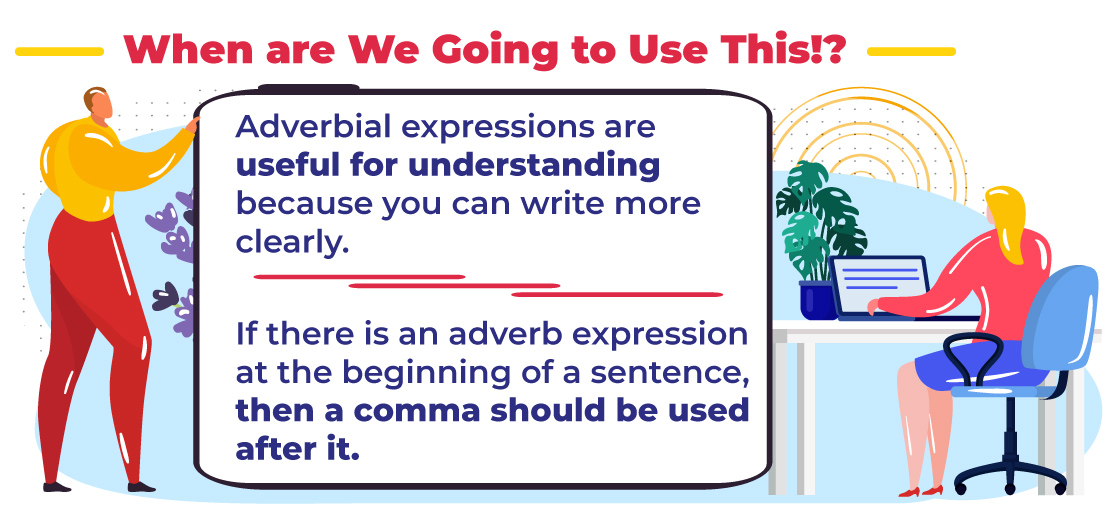
Adverbial clauses are helpful to understand because you can write more clearly.
However, there is another reason why understanding adverbial clauses are so important. When you understand adverb clauses, you'll be able to use commas more correctly.
I remember when I was first learning commas at some point, I learned the classic "put a comma anywhere you would naturally take a breath while talking."
Now that I have learned the actual rules for commas, I know that isn't true. So what do adverbial clauses and commas have to do with each other?
When an adverbial clause is at the beginning of a sentence, then you should use a comma following the adverbial. This has an official name called a frontal adverbial. You can commonly see this happening in examples like:
And in conclusion, I think that commas should be used correctly.
When your adverbial clause is at the end of a sentence, then generally, you will not use a comma.
Of course, there are exceptions to these rules. If you are writing an adverbial clause into the back-end of your sentence and you think a comma helps, add it!
Conclusion

As with any part of speech, adverbial clauses add richness to your writing. When you include adverb clauses, you can increase detail and, in result, improve understanding.
If you struggle with understanding parts of speech, grammatical, and usage rules, you may benefit from a workbook from ArgoPrep.
[subscribe=20543]ArgoPrep has worked with teachers to create a consistent practice that will help you improve your writing and understanding of the English language.
Whether you are trying to score higher on an assessment or trying to write more clearly, ArgoPrep has the resource to help you improve!